
5.
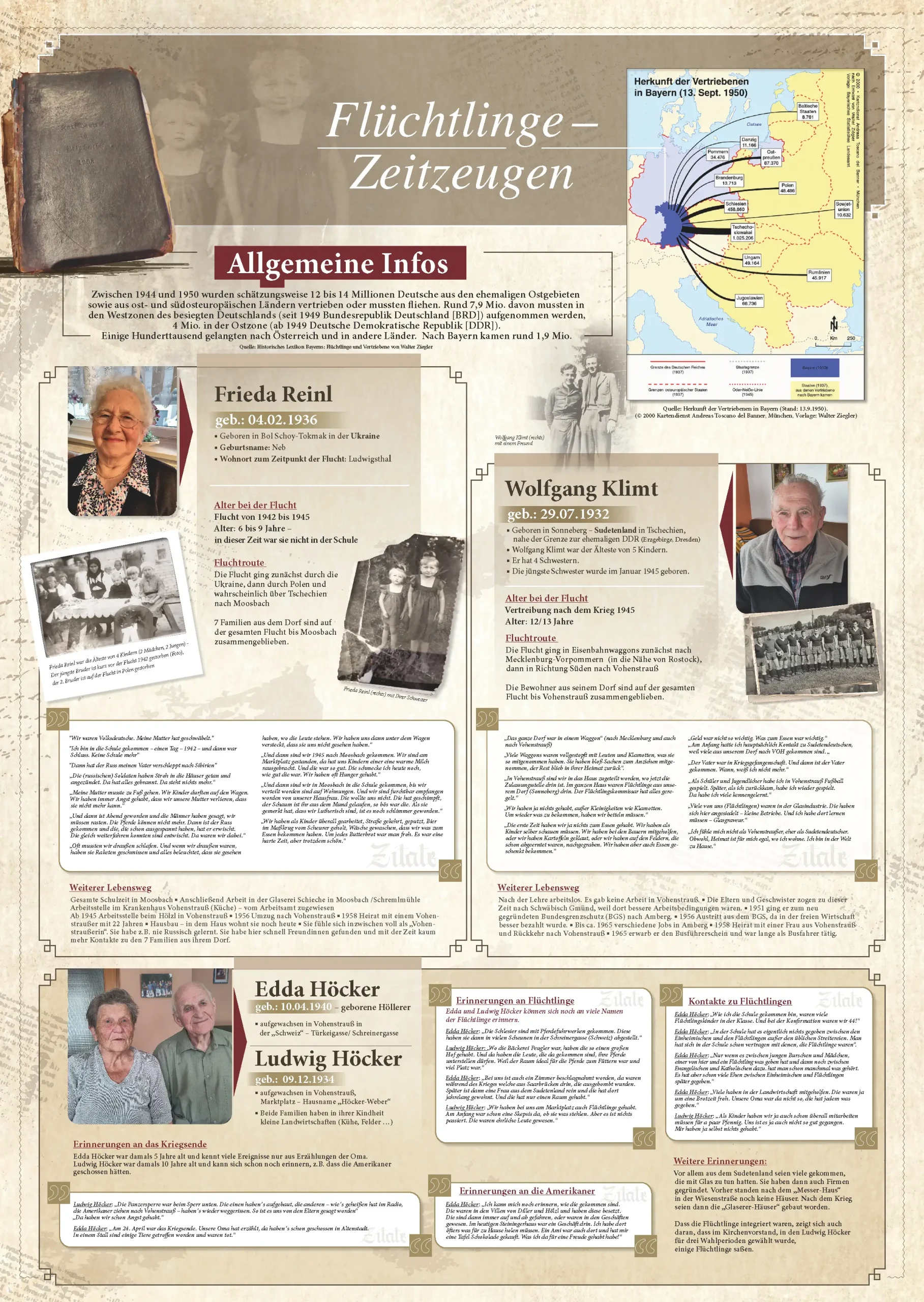
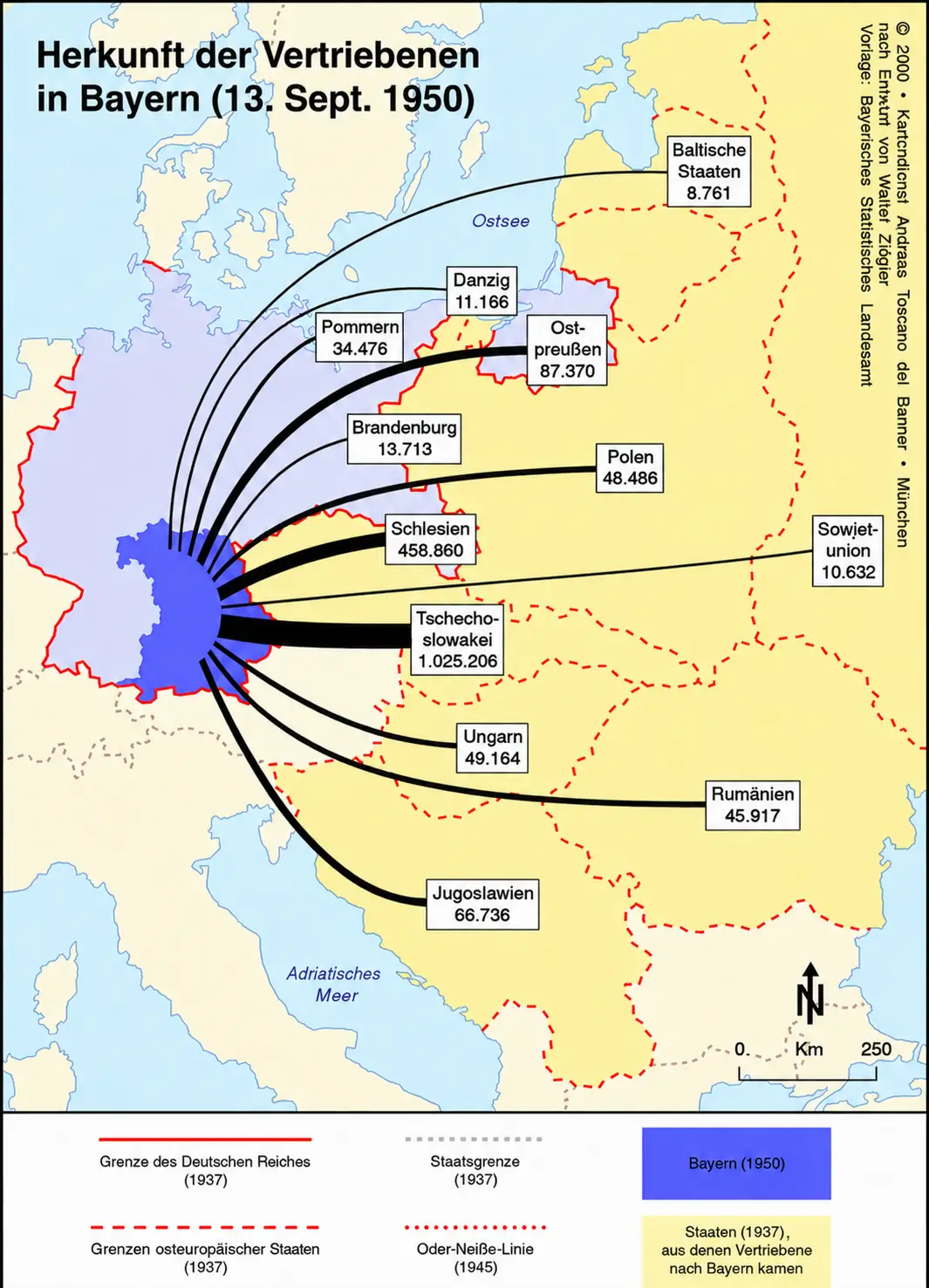
Between 1944 and 1950, an estimated 12 to 14 million Germans were expelled from the former eastern territories as well as from countries in Eastern and Southeastern Europe, or were forced to flee. Of these, approximately 7.9 million had to be taken in by the Western Zones of defeated Germany (the Federal Republic of Germany [FRG] since 1949), and 4 million by the Eastern Zone (the German Democratic Republic [GDR] from 1949 onward). Several hundred thousand made their way to Austria and other countries. Around 1.9 million came to Bavaria.

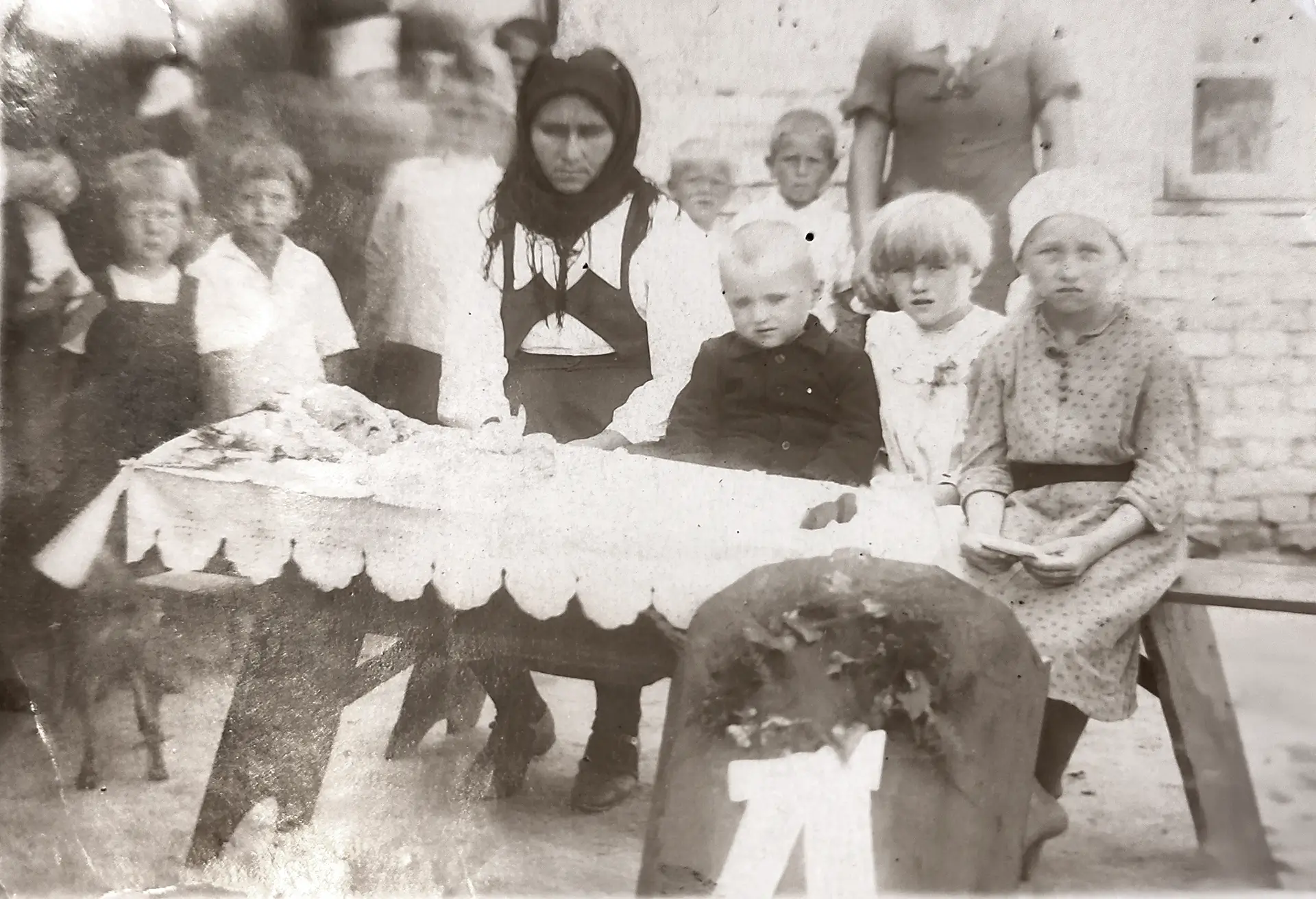
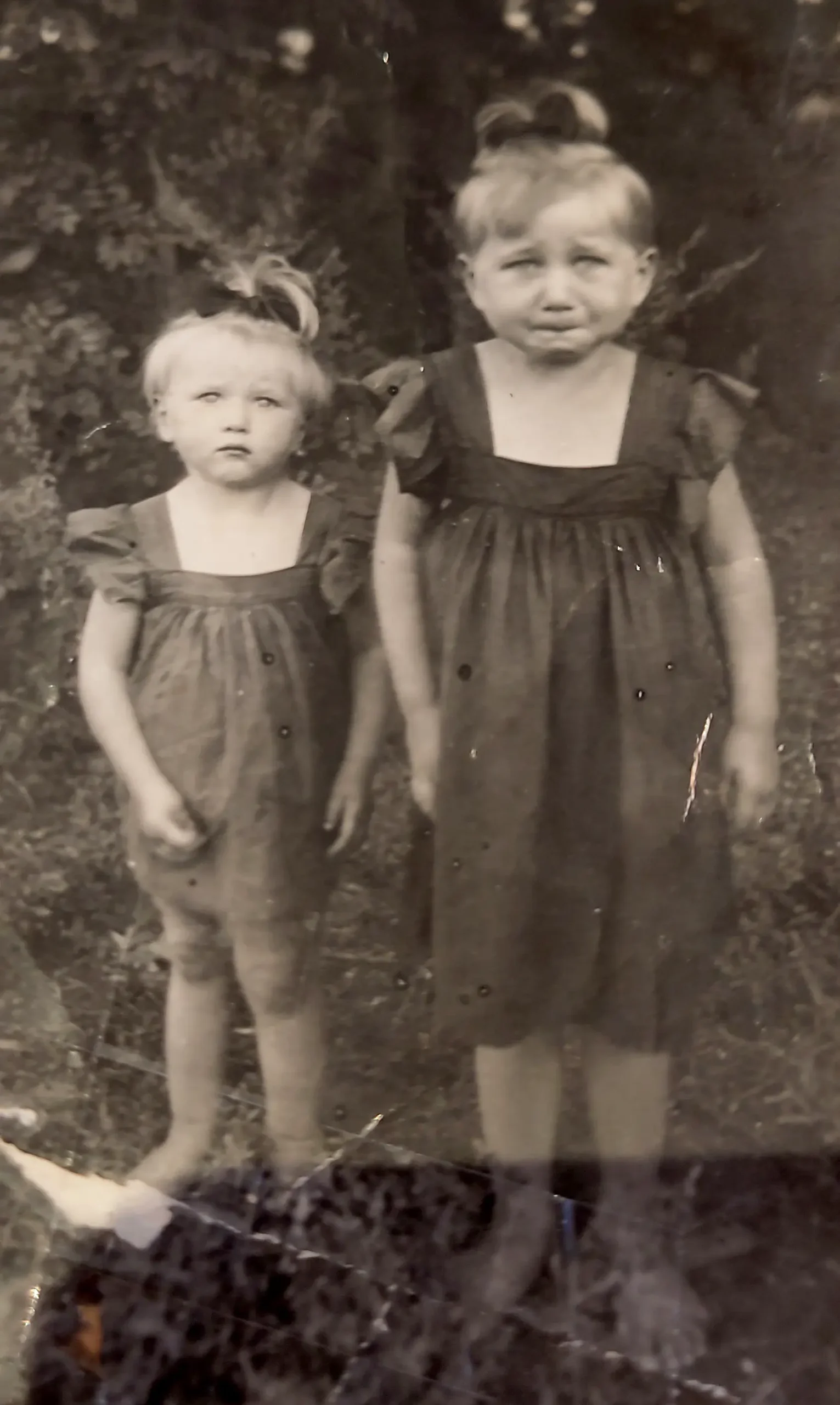
Born: February 4, 1936
Age at the time of flight
In exile from 1942 to 1945
Age: 6 to 9 years old –
She did not attend school during this time.
Escape route
The escape route initially took them through Ukraine, then through Poland, and probably via the Czech Republic to Moosbach
Seven families from the village stayed together throughout their entire journey to Moosbach.
Quotes
“We were ethnic Germans. My mother spoke with a Swabian accent.”
“I went to school—for one day—in 1942—and then that was it. No more school.”
“Then the Russian took my father away to Siberia.”
“The (Russian) soldiers put straw in the houses and set it on fire. Everything burned down. There’s nothing left.”
“My mother had to walk. We kids were allowed to ride in the wagon. We were always afraid that we’d lose our mother, that she wouldn’t be able to go on anymore.”
“And then evening came, and the men said we had to rest. The horses couldn’t go any further. Then the Russian came and caught those who had already unharnessed their horses. Those who were able to keep going right away managed to escape. We were among them.”
“We often had to sleep outside. And when we were outside, they fired rockets and lit up everything so they could see where people were standing. We’d hide under the car so they wouldn’t see us.”
“And then we came to Moosbach in 1945. We were standing in the town square when someone brought us kids a cup of warm milk. And it was so good. I can still taste it today—it was that good. We were often hungry.”
“And then we arrived at the school in Moosbach, until we were assigned to apartments. And we were given a terrible welcome by our landlady. She didn’t want us there. She ranted and raved—foam was coming out of her mouth, she was so angry. When she realized we were Lutherans, it got even worse.”
“As kids, we worked everywhere—sweeping streets, cleaning, fetching beer in a Maßkrug from Scheurer, doing laundry—just so we could get something to eat. We were happy for every slice of bread with butter. It was a hard time, but still a good one.”
The Rest of One’s Life
Attended school in Moosbach throughout her schooling ■ Subsequently worked at the Schieche Glassworks in Moosbach/Schremlmühle
Worked at the Vohenstrauß Hospital (kitchen)—assigned by the employment office
Beginning in 1945, worked at Hölzl in Vohenstrauß ■ 1956: Moved to Vohenstrauß ■ 1958: Married a man from Vohenstrauß at age 22 ■ Built a house—she still lives in that house today ■ She now feels fully like a “Vohenstrauß native.” For example, she never learned Russian. She quickly made friends here and, over time, has had almost no contact with the seven families from her village.
Interview mit Frieda Reinl zum Anhören
Born: July 29, 1932
Age at the time of flight
Displacement after the war in 1945
Age: 12/13 years
Escape route
The escape took place in railroad cars, first to Mecklenburg-Western Pomerania (near Rostock), then southward to Vohenstrauß
The residents of his village stayed together throughout their entire journey to Vohenstrauß.
Quotes
“The whole village was in one train car” (to Mecklenburg and also to Vohenstrauß)
“Many train cars were crammed with people and clothes—whatever they had managed to bring with them. They took only the clothes on their backs; the rest was left behind in their homeland.”
“In Vohenstrauß, we were assigned to the house that now houses the registration office. The entire house was filled with refugees from our village (Sonneberg). The refugee commissioner took care of everything.”
“We didn’t have anything, really, except for little things like clothes. To get anything again, we had to beg.”
“At first, we didn’t have anything to eat. As kids, we had to fend for ourselves. We helped out on the farms, or we stole potatoes, or we dug through the fields that had already been harvested. But we also received food as gifts.”
“Money wasn’t that important. Having something to eat was what mattered.”
“At first, I mainly had contact with Sudeten Germans, because many people from our village had come to VOH.”
“My father was a prisoner of war. And then my father came home. I don’t remember when.”
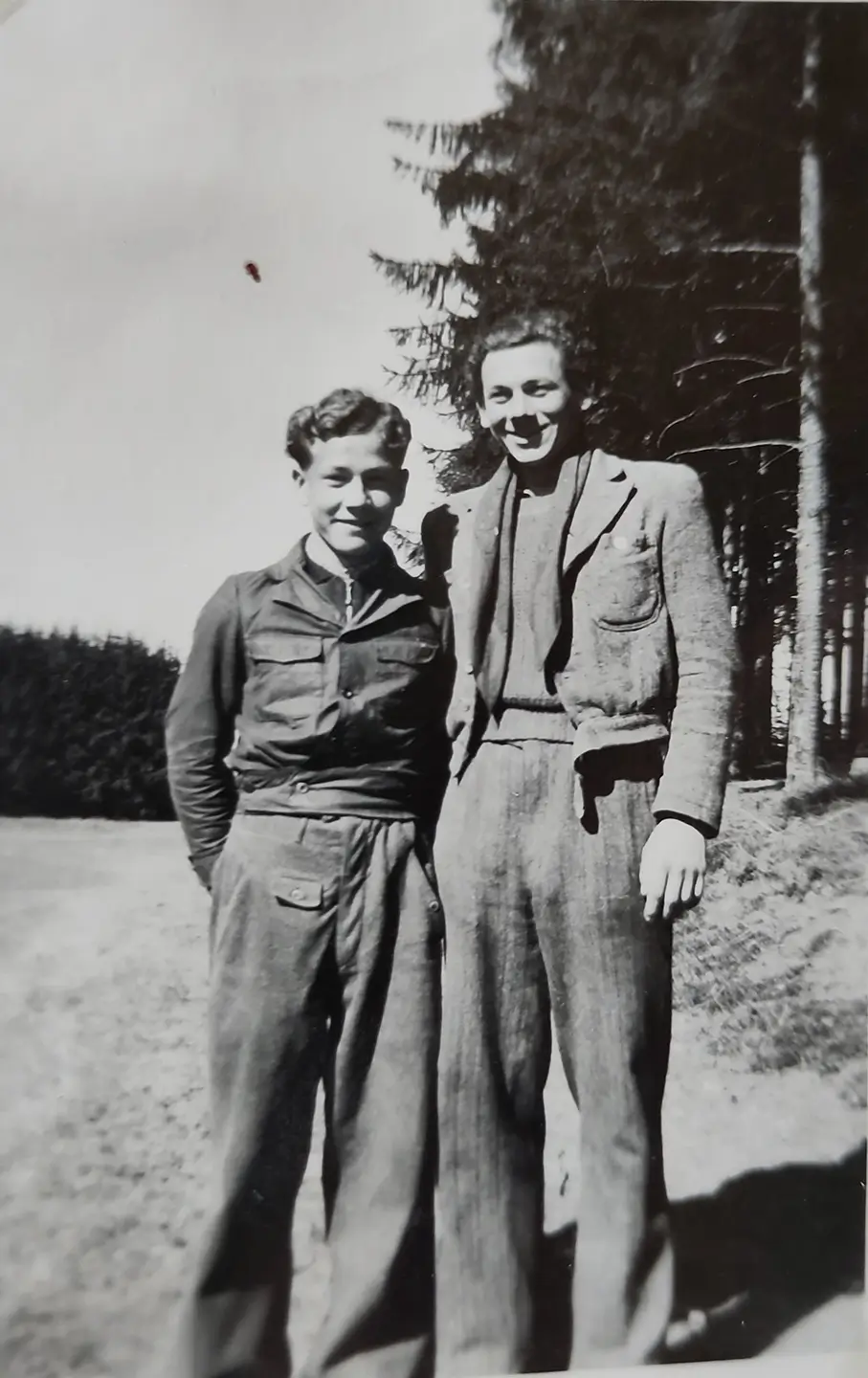
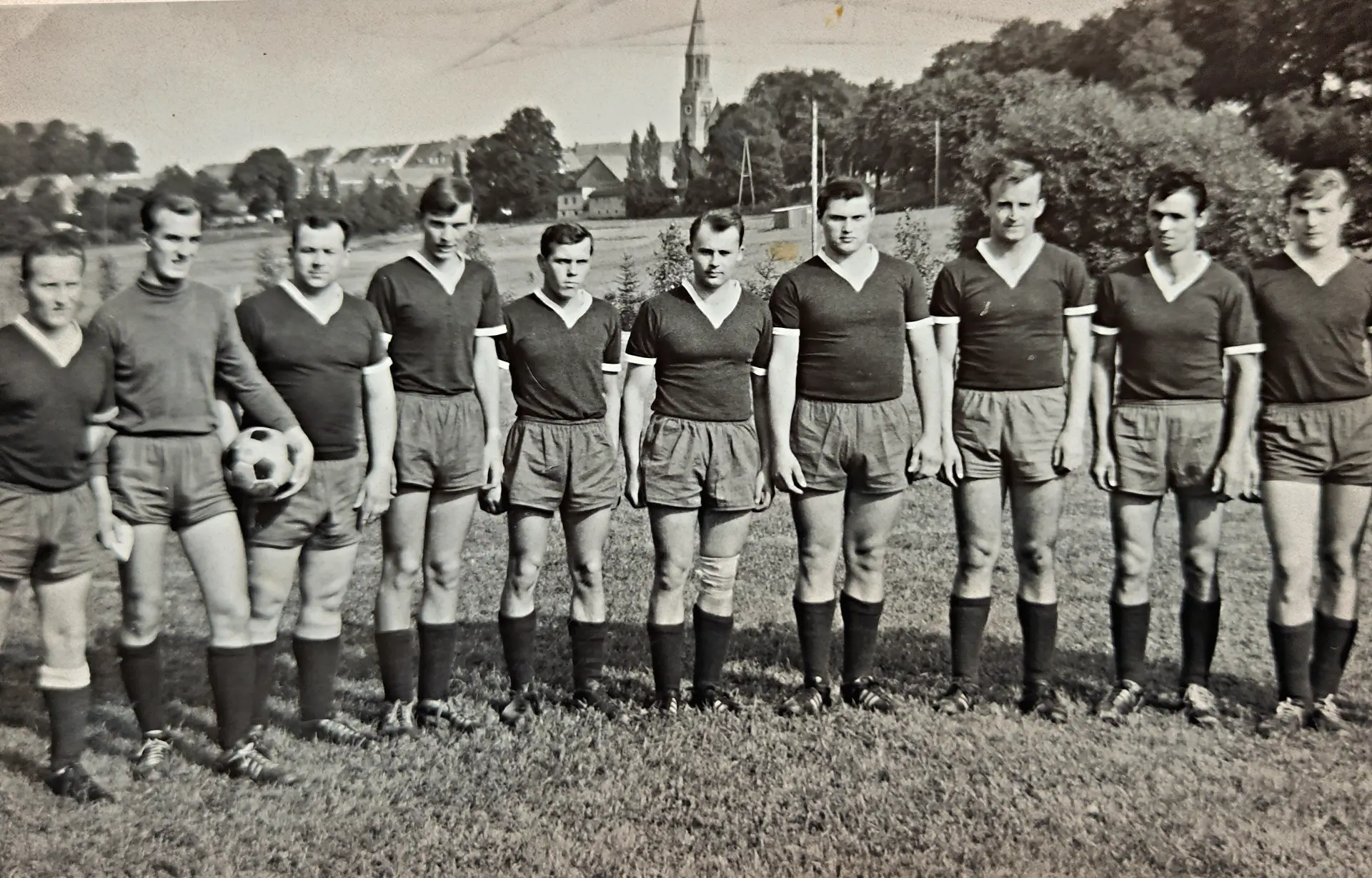
“When I was in school and as a teenager, I played soccer in Vohenstrauß. Later, when I came back, I started playing again. That’s when I got to know a lot of people.”
“Many of us (refugees) worked in the glass industry. They set up shop here—small businesses. And I had to learn the trade there—as a glass engraver.”
“I don’t feel like I’m from Vohenstrauß; I feel more like a Sudeten German. Although, for me, home is wherever I live. I’m at home in the world.”
The Rest of One’s Life
Unemployed after completing his apprenticeship. There were no jobs in Vohenstrauß. ■ His parents and siblings moved to Schwäbisch Gmünd at that time because working conditions were better there. ■ In 1951, he joined the newly established Federal Border Guard (BGS) in Amberg. ■ In 1956, he left the BGS because jobs in the private sector paid better. ■ Held various jobs in Amberg until around 1965 ■ Married a woman from Vohenstrauß in 1958 and returned to Vohenstrauß ■ In 1965, he obtained his bus driver’s license and worked as a bus driver for many years.
Interview mit Wolfgang Klimt zum Anhören
Edda Höcker (born April 10, 1940 – née Höllerer)
Ludwig Höcker (born December 9, 1934)
Memories of the End of the War
Edda Höcker was 5 years old at the time and knows about many of these events only from her grandmother’s stories.
Ludwig Höcker was 10 years old at the time and can still remember, for example, that the Americans were shooting.
Ludwig Höcker: “The tank barrier was down at Sperr. Some people set it up, while others—as the radio reported that the Americans were advancing toward Vohenstrauß—tore it down again. That’s what our parents told us.”
“We were really worried at that point.”
Edda Höcker: “The war ended on April 24. Our grandmother told us that there was already shooting going on in Altenstadt at that time. Some animals in a barn were hit and killed.”
Memories of Refugees
Edda and Ludwig Höcker can still remember many of the refugees’ names.
Edda Höcker: “The Silesians arrived in horse-drawn carts. They then parked them in many barns on Schreinergasse (Switzerland).”
Ludwig Höcker: “Where the Peugler Bakery used to be, they had a big courtyard. And people who came there were allowed to tie up their horses there. Because the space was ideal for feeding the horses, and there was plenty of room.”
Edda Höcker: “One of our rooms was also requisitioned; during the war, there were people from Saarbrücken staying there who had been displaced by bombing. Later, a woman from the Sudetenland moved in and lived there for years. And she only had one room.”
Ludwig Höcker: “We’ve also had refugees at our market. At first, there was some skepticism about whether they might steal anything. But nothing happened. They turned out to be honest people.”
Memories of the Americans
Edda Höcker: “I can still remember how they arrived. They were at the Diller and Hölzl villas and had occupied them. They would drive back and forth all the time, or go into the stores. There was a store in what is now the Steiningerhaus. I often had to go there to pick up things for the house. An American was there, too, and he bought me a bar of chocolate. I was so happy!”
Contacts with Refugees
Edda Höcker: “When I started school, there were a lot of refugee children in my class. And at our confirmation, there were 44 of us!”
Edda Höcker: “At school, there really wasn’t any tension between the locals and the refugees—just the usual arguments. We got along just fine with the refugees at school.”
Edda Höcker: “Only when there’s been a romance between young men and women—one from here and one who’s a refugee—and on top of that between Protestants and Catholics—have people sometimes heard about it. But there have been many marriages between locals and refugees over the years.”
Edda Höcker: “A lot of people helped out on the farm. They were happy just to get a snack. Our grandma wasn’t like that—she gave everyone something.”
Ludwig Höcker: “Even as kids, we had to work here and there for a few pfennigs. Things weren’t exactly great for us, either. I didn’t have anything myself.”
More memories:
Many people involved in the glass industry came mainly from the Sudetenland. They went on to start their own companies. Before that, there were no houses beyond the “Messer House” on Wiesenstraße. After the war, the “Glaserer Houses” were built.
The fact that the refugees were integrated is also evident from the fact that several refugees served on the church council, to which Ludwig Höcker was elected for three terms.
Interview mit Edda und Ludwig Höcker zum Anhören
Memories of World War II and the First Years After the War Ended
I was seven years old when the war broke out. I secretly went to the Hitler Youth meetings, even though my parents were against it. There, we had to pick tea leaves for the soldiers. We also played ball games and other games. The secondary school I attended was closed after a year and a half. After that, we had no classes at all for half a year. I could have gone to the high school in Weiden, but we didn’t have the money for that. So I transferred, along with my classmates, to the elementary school in Vohenstrauß. There, we had many substitute teachers.
During the war, we continued to tend our fields and actually lived without fear. During the Hitler era, houses had to be blacked out in the evenings. We weren’t allowed to look out the window. A man checked to make sure everyone was following this rule. Mr. Gehret visited Jewish residents in Weiden who were no longer allowed to leave their homes and provided them with basic necessities. He came to our house regularly and told us about what was happening in Flossenbürg. My mother was very afraid that someone might be eavesdropping outside the house.
My Father During the War
My father was drafted in 1941 or 1942 and returned in 1947. He was a master carpenter, the oldest and one of the last to be drafted in Vohenstrauß. Rumor had it that another man was actually supposed to have been drafted. However, since my father was not a member of the party, he was drafted instead. He had blood type O, which was in high demand during the war. At first, my father was stationed in Regensburg, and later in Nuremberg. He was not granted leave for harvest work until after the house in Vohenstrauß had been transferred to his name. In Regensburg and Nuremberg, he worked as a carpenter for the soldiers. He was assigned to the anti-aircraft artillery and had to complete training for that role. He was subsequently deployed to Russia. On the journey to the front, he fell ill in a cattle car. As a result, he had to be hospitalized in Wörgl, Austria. Some time later, he arrived in Norway. There, he was no longer granted leave for the harvest.
The End of the War and My Father’s Return Home
My father was taken prisoner by the Americans. He didn’t think highly of the Americans because they had handed the prisoners over to the French. At first, he was in a camp in France. Later, he was put to work for winegrowers. In the summer of 1947, my father returned home, a few months after my confirmation. In Weiden, he and another former prisoner of war asked the Red Cross for a piece of bread. At first, they were refused. They only received it after they promised to return it.
“To us, my father was a stranger when he came home.”
The End of the War in Vohenstrauß
No bombs fell on Vohenstrauß during the war. At some point, we rode in a handcart to the villa in Fiedlbühl. There, we heard gunshots very close by.
The Nazis were stationed in the town hall in Vohenstrauß. At first, they prevented the Americans from entering Vohenstrauß. The Werwolf organization had blocked the road further down.
On the first day the Americans arrived in Vohenstrauß, one of them was shot. As a result, they withdrew. Some time later, they returned to Vohenstrauß. By then, the Nazis had fled Vohenstrauß. Reportedly, Mr. Steininger walked down the street toward the Americans carrying a white flag. However, I did not see this myself. Accompanied by the Americans and carrying his white flag, he drove into Vohenstrauß in a jeep. When the Americans arrived, we were in the Gehret family’s air-raid shelter. There was a regular basement and, much further down, the rock-cut cellar. The Seitz family, who owned a grocery store, was also in the Gehret family’s air-raid shelter. On the day of the siege, quite a few houses were damaged. Our house had numerous bullet holes from shrapnel. In addition, the windows had been shattered by the explosions. That’s why we had to board them up.
There was a huge bullet hole in the Höcker family’s house next door. A large hole had opened up in the ground near the Wittmann family’s house. There had been a fire across from the Protestant parsonage. During the American siege, we were only allowed outside for a few hours a day. The rest of the time, a curfew was in effect. The houses starting with the Weidner family’s, heading up and to the right, had to be vacated for the Americans. Americans had taken up quarters at the Schöfer’s, as well as at the Hölzl factory and the porcelain factory. We children would occasionally meet a nice American at the market square. He would give us something and was very friendly to us. We would sometimes tease him for fun, and he was happy to play along. We received meat ration coupons, but we had no money to redeem them. We didn’t care about the currency devaluation, since we didn’t have any cash anyway.
Memories of Refugees Arriving
There was no forced housing in our family. My mother voluntarily took in strangers who had asked her to. Five refugees lived with us in a room on the first floor: a woman over 50 years old, her 80-year-old father, and her 16-year-old son. Their last name was Schmieowski. The woman helped my mother with the farm work. Two other women also lived with us: a 25-year-old and her 14-year-old sister. Their mother, who was German, had died in Czechoslovakia. Their father was Russian and seriously ill. He was admitted to the hospital in Vohenstrauß, where he died. He was buried in Vohenstrauß. The 25-year-old woman helped my mother with the laundry. The 16-year-old boy regularly went to see the Americans at the porcelain factory. From there, he brought back coffee grounds, which were then dried. Later, they took the powder with them to Nuremberg. Every now and then, the boy also brought back food from the Americans, such as potato salad. The refugees didn’t have to go hungry at our house. Mr. Weidner wouldn’t let the refugees stay in Vohenstrauß, even though they would have liked to stay there. Everyone had to go to a camp in Nuremberg. Later, another woman asked us for a room for her mother. She herself, her husband, and her daughter were staying with the Stahl family. However, they cooked and ate at our house. The elderly woman sewed underwear for me out of tablecloths that had been part of my father’s wedding trousseau. Later, she moved into a nursing home.
Refugees and Public Sentiment
“Nobody liked the refugees. They arrived around 1945.”
Among the refugees were, for example, Ruth Knechtel and Mrs. Janner, who is still alive today. The atmosphere wasn’t particularly good because the refugees were housed with local residents. We children got along well with the refugee children at school. We went to the youth group together. Ruth Knechtel was my friend. The refugees were not malnourished. They received school meals. Gehret leased his farm to a refugee. This caused a great deal of trouble because the refugee had sold all the cows without permission.
Gehret also helped with denazification—that is, exposing former Nazis. This took place at City Hall. After the war, we were weighed. I was malnourished.
Interview mit Irmgard Eberhardt zum Anhören



The project “Between Democracy and Dictatorship” is supported by “Neustadt lebt Demokratie,” the Evangelical Adult Education Center of the Upper Palatinate, the Federal Ministry of Education, Family, Senior Citizens, Women, and Youth, and the federal program “Demokratie leben!”
Together, the funding partners help preserve history, strengthen democratic awareness, and promote diversity, respect, and social cohesion.