3.

Supply Situation After 1945

Orders from the U.S. Military Government

Excerpts Regarding Care

document.addEventListener('DOMContentLoaded', () => { const tafel = document.querySelector('.tafel'); const title = document.querySelector('.title'); if (!tafel || !title) return; function positionTafel() { if (window.innerWidth <= 1024) { tafel.style.top = ''; tafel.style.opacity = ''; tafel.style.pointerEvents = ''; return; } const tafelRect = tafel.getBoundingClientRect(); const titleRect = title.getBoundingClientRect(); const difference = titleRect.top - tafelRect.top; const currentTop = parseFloat(getComputedStyle(tafel).top) || 0; tafel.style.top = (currentTop + difference) + 'px'; checkTafelVisibility(); } function checkTafelVisibility() { if (window.innerWidth = pageBottom - offsetBottom) { tafel.style.opacity = '0'; tafel.style.pointerEvents = 'none'; } else { tafel.style.opacity = '1'; tafel.style.pointerEvents = ''; } } positionTafel(); window.addEventListener('resize', positionTafel); window.addEventListener('load', positionTafel); window.addEventListener('scroll', checkTafelVisibility, { passive: true }); const observer = new ResizeObserver(() => { positionTafel(); }); observer.observe(title); if (tafel.offsetParent) { observer.observe(tafel.offsetParent); } }); .tafel { transition: opacity 0.85s ease; }

Care & Daily Life

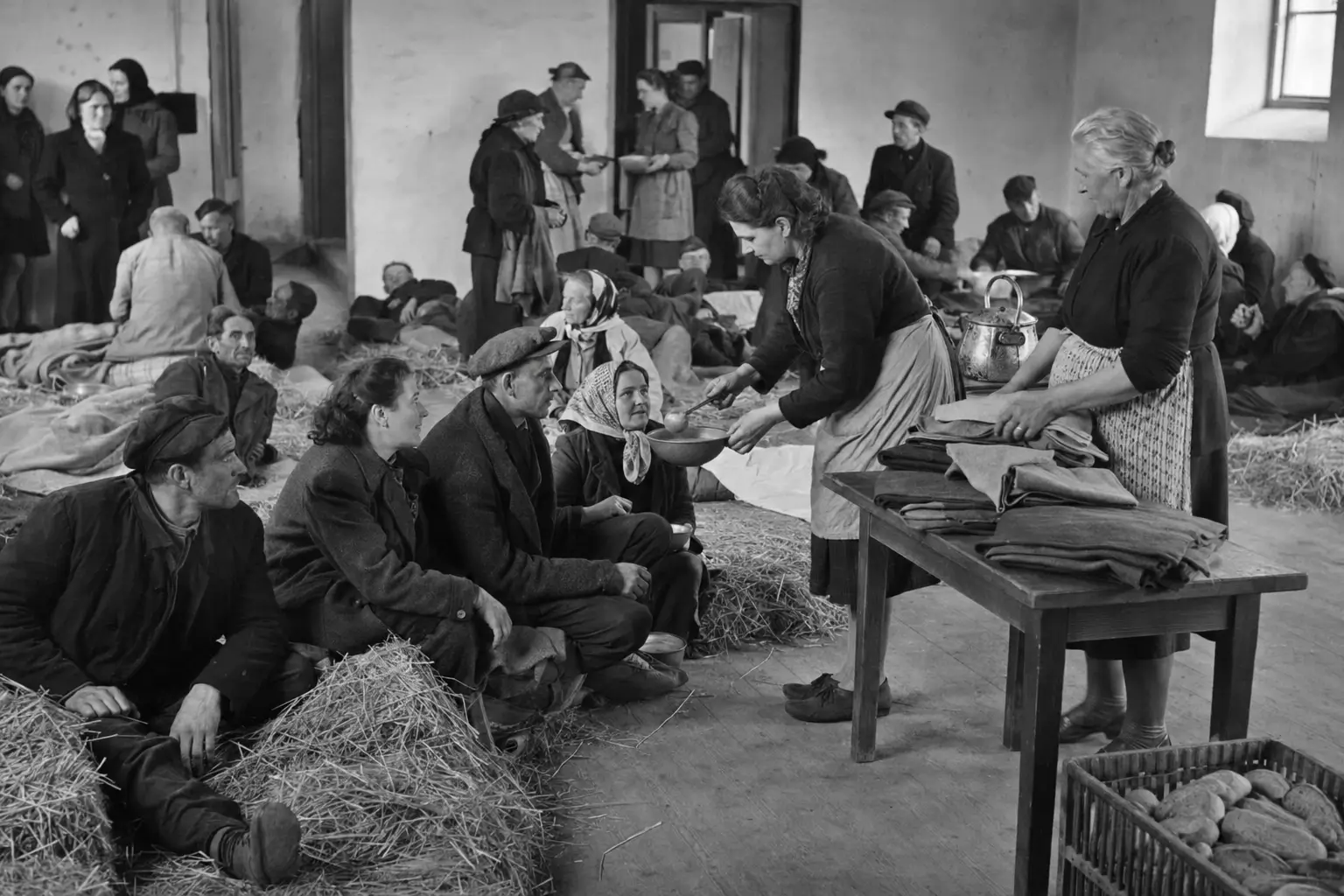
April 27, 1945: Prisoners of war must be provided with food and shelter.

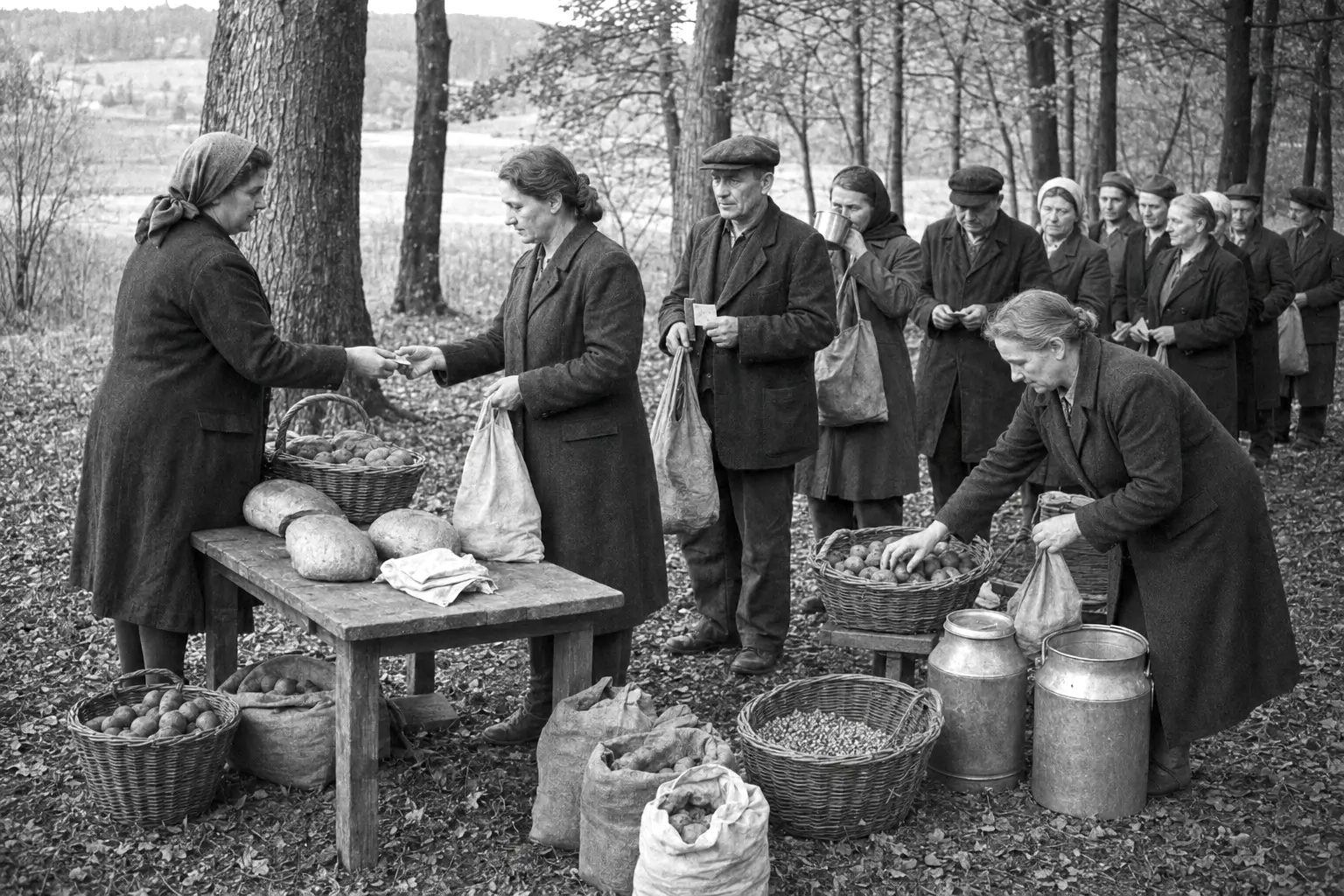
May 23, 1945: Horses and vehicles abandoned by the Wehrmacht are to be inventoried.

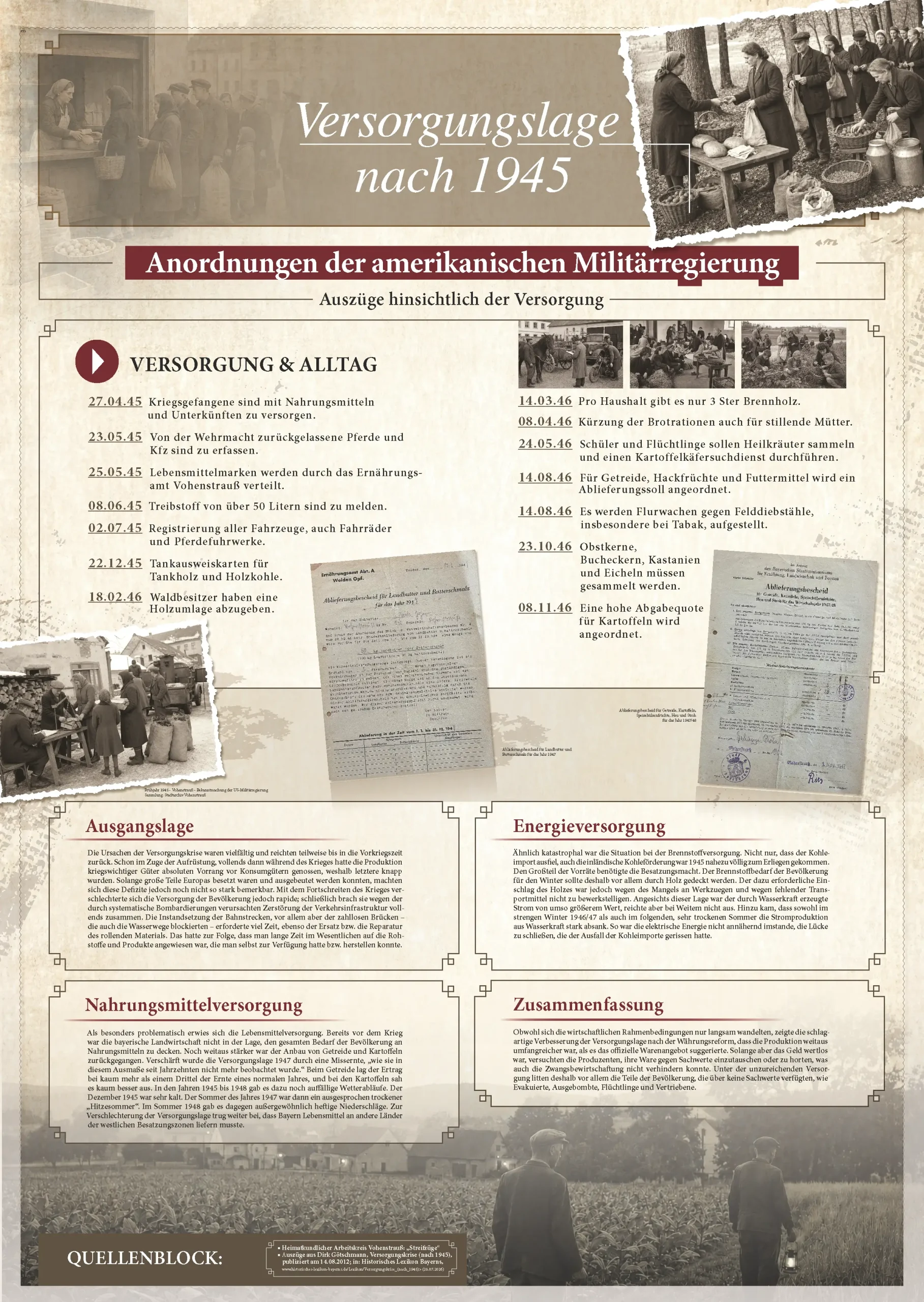
May 25, 1945: Food ration coupons are distributed by the Vohenstrauß Food Distribution Office.

June 8, 1945: Any amount of fuel exceeding 50 liters must be reported.

July 2, 1945: Registration of all vehicles, including bicycles and horse-drawn carts.

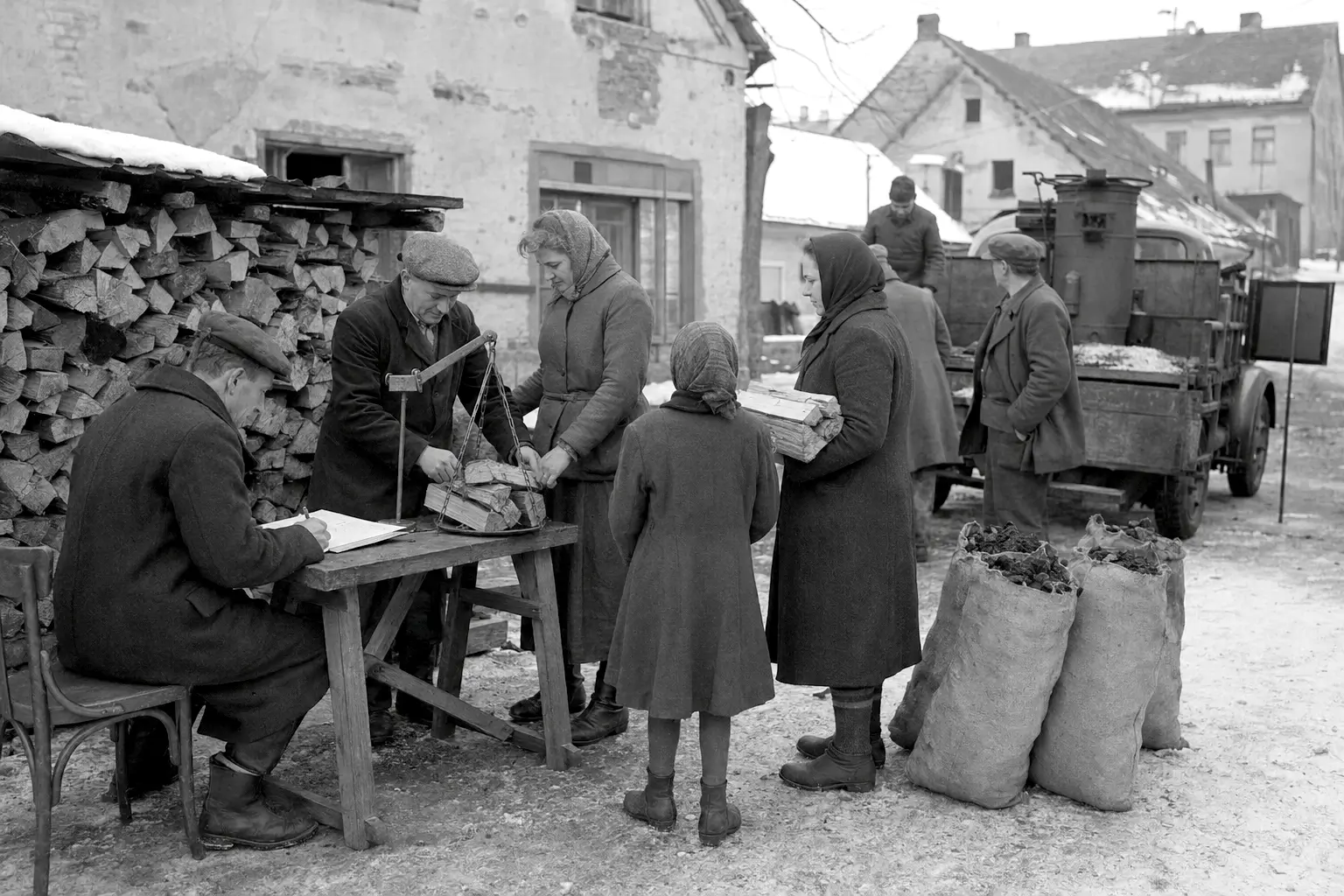
December 22, 1945: Fuel ration cards for firewood and charcoal.

February 18, 1946: Forest owners are required to pay a timber levy.

March 14, 1946: Each household is allotted only 3 ster of firewood.

April 8, 1946: Bread rations were cut even for nursing mothers.

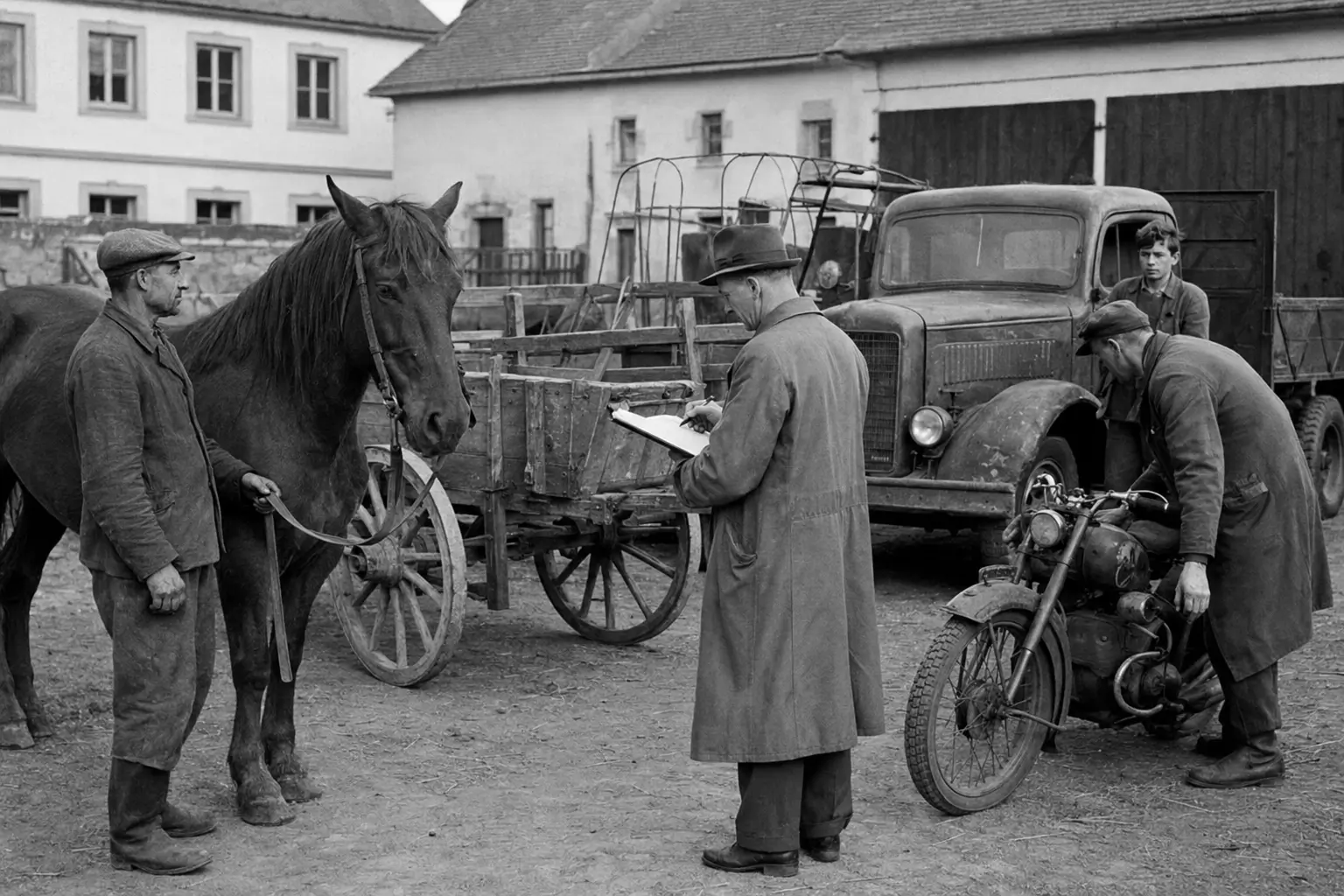
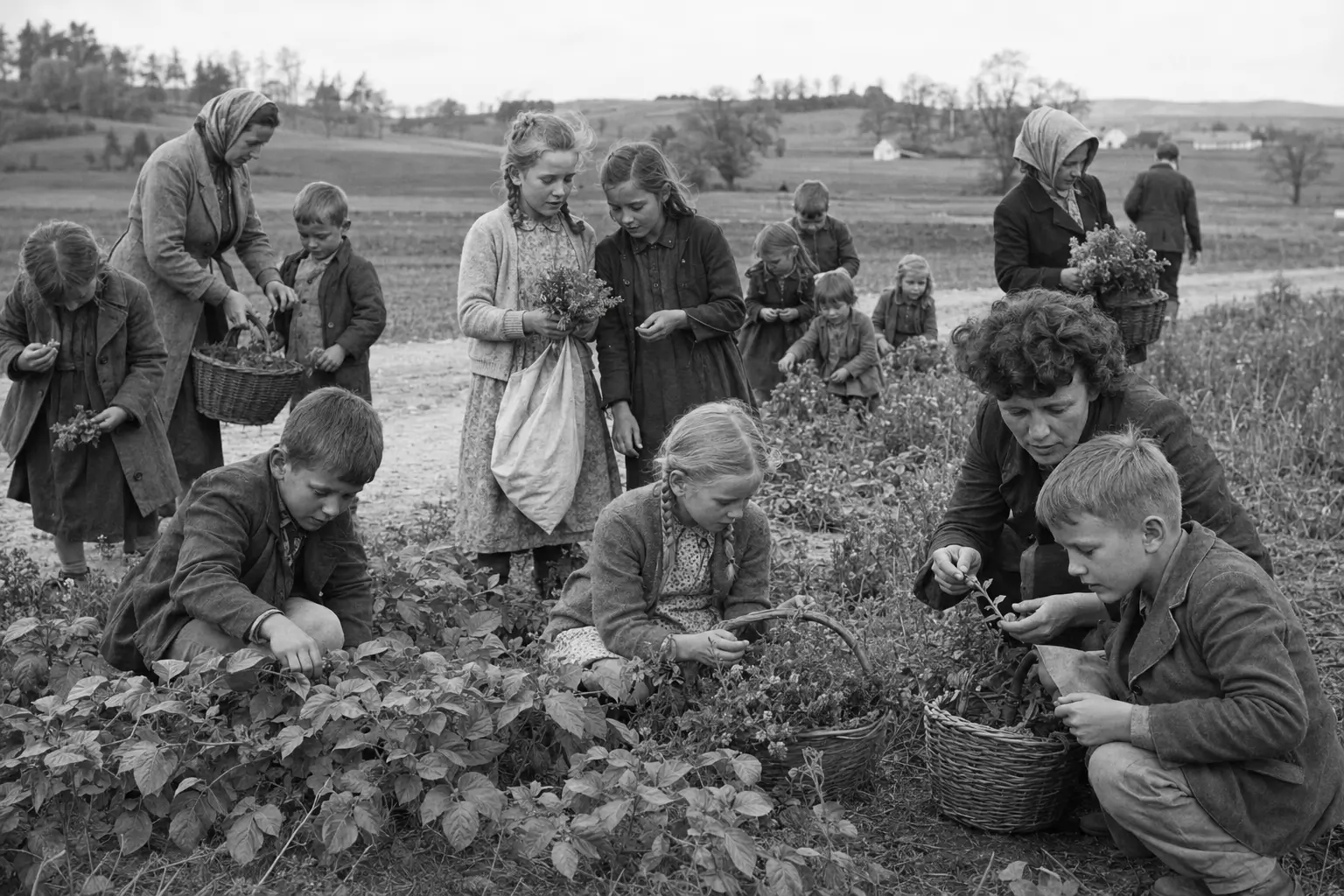
May 24, 1946: Students and refugees are to collect medicinal herbs and conduct a potato beetle search.

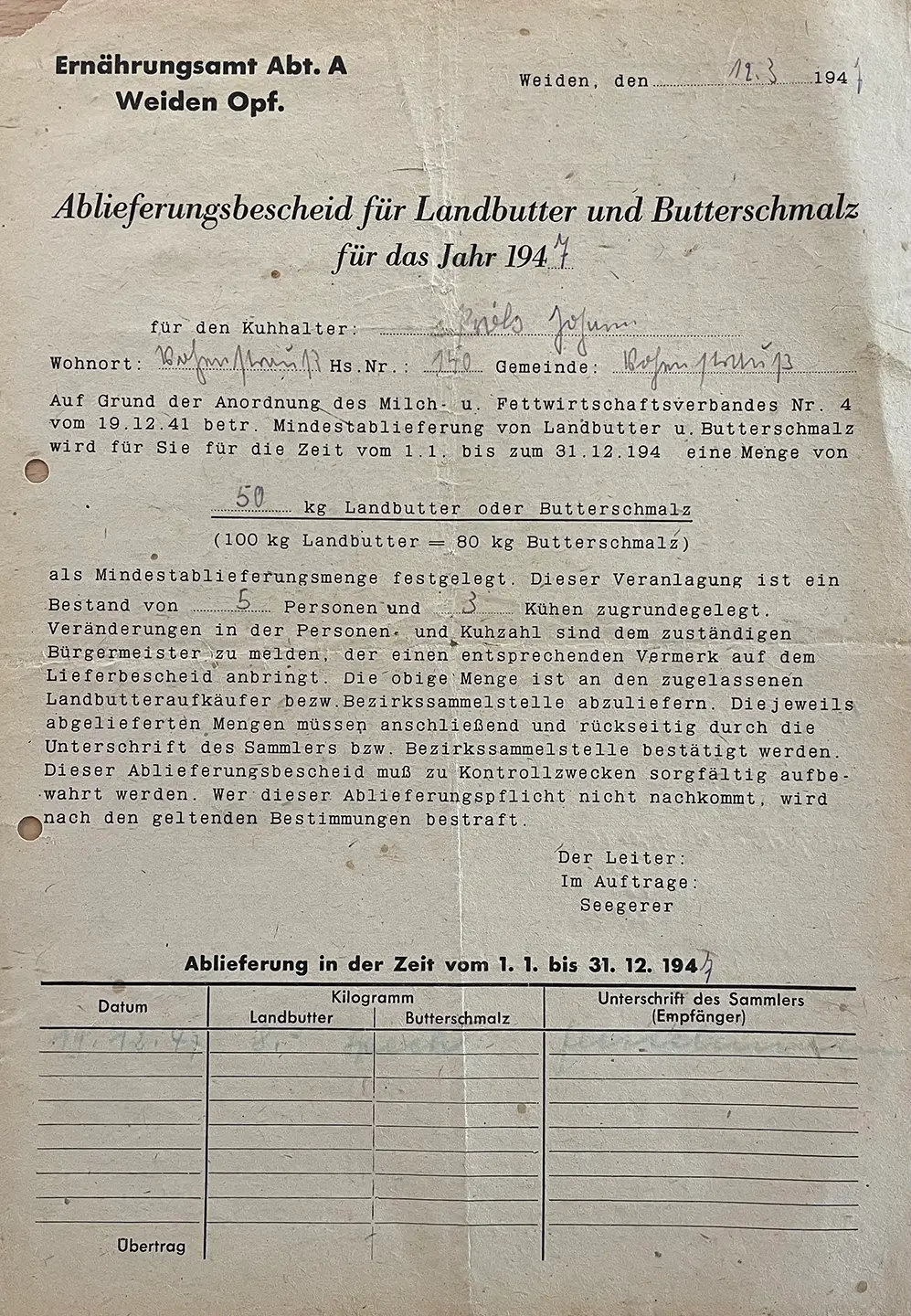
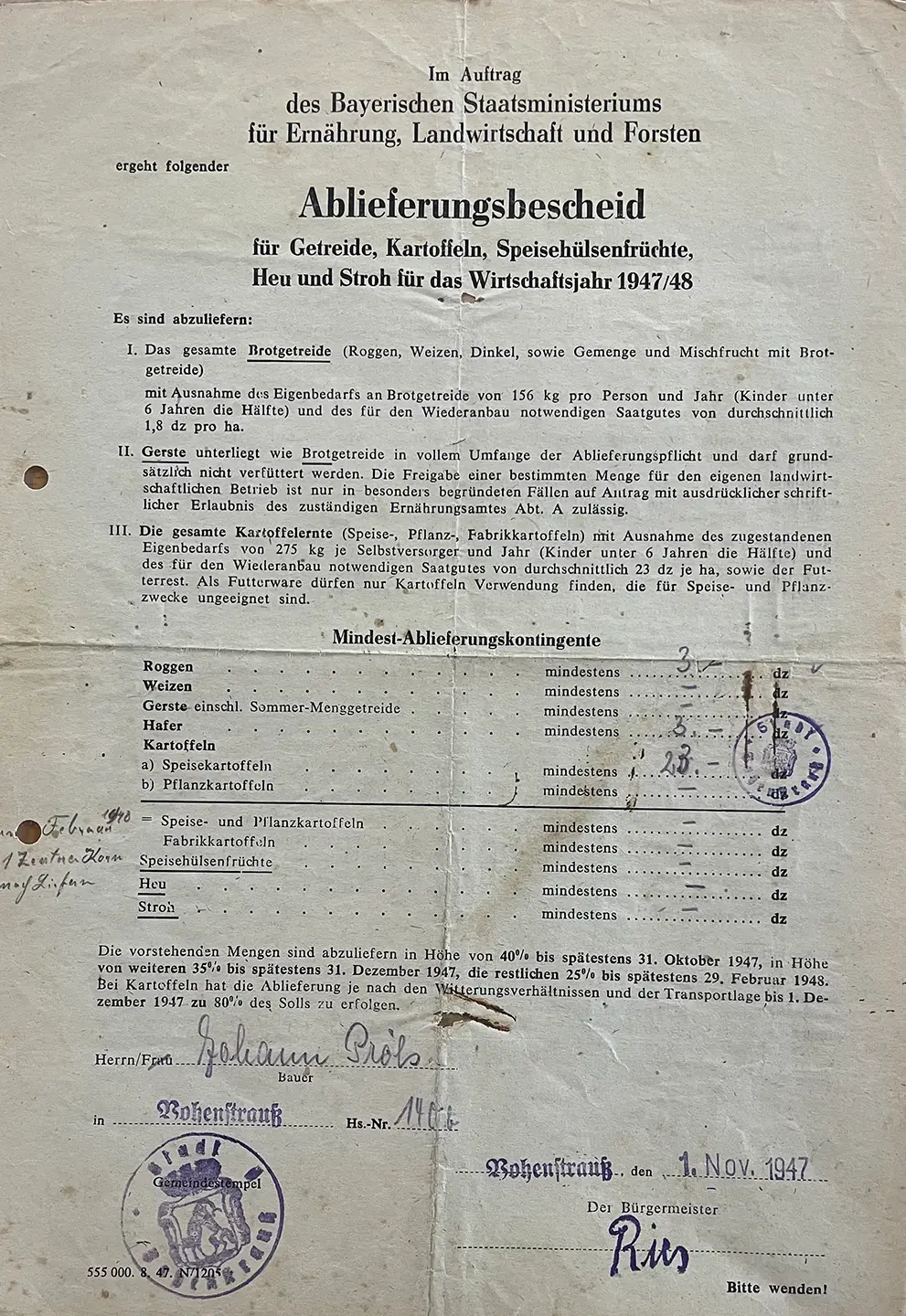
August 14, 1946: A mandatory delivery quota is imposed for grain, root crops, and feed.

August 14, 1946: Field guards are deployed to prevent crop theft, particularly of tobacco.

October 23, 1946: Fruit pits, beech nuts, chestnuts, and acorns must be collected.

November 8, 1946: A high levy rate on potatoes is imposed.

Background

The causes of the supply crisis were manifold and, in some cases, dated back to the prewar period. Already during the buildup—and fully so during the war—the production of goods essential to the war effort had taken absolute priority over consumer goods, which is why the latter became scarce. However, as long as large parts of Europe remained occupied and could be exploited, these shortages were not yet very noticeable. As the war progressed, however, the supply situation for the population deteriorated rapidly; eventually, it collapsed entirely due to the destruction of the transportation infrastructure caused by systematic bombing. Repairing the railroad lines—and above all the countless bridges, which also blocked the waterways—took a great deal of time, as did the replacement or repair of rolling stock. As a result, for a long time the country was essentially dependent on the raw materials and products it had available or could produce itself.

Energy Supply

The situation regarding the fuel supply was similarly dire. Not only had coal imports ceased, but domestic coal production had also come to a near standstill in 1945. The occupying forces required the majority of the supplies. The population’s fuel needs for the winter were therefore to be met primarily with wood. However, the logging required for this purpose could not be carried out due to a lack of tools and transportation. Given this situation, electricity generated by hydropower was all the more valuable, but it was by no means sufficient. In addition, hydroelectric power generation dropped sharply both during the harsh winter of 1946–47 and the following, very dry summer. As a result, electrical power was nowhere near sufficient to fill the gap left by the loss of coal imports.

Food Supply

The food supply proved to be particularly problematic. Even before the war, Bavarian agriculture had been unable to meet the population’s total food needs. The cultivation of grain and potatoes had declined even more sharply. The supply situation was exacerbated in 1947 by a crop failure “on a scale not seen in decades.” The grain yield was barely more than one-third of a normal year’s harvest, and the situation was hardly any better for potatoes. From 1945 to 1948, there were also notable weather patterns. December 1945 was very cold. The summer of 1947 was then an exceptionally dry “heat wave.” In the summer of 1948, by contrast, there was unusually heavy rainfall. The supply situation was further exacerbated by the fact that Bavaria had to supply food to other states in the Western occupation zones.

Summary

Although economic conditions changed only slowly, the sudden improvement in the supply situation following the currency reform showed that production was far more extensive than the official supply of goods suggested. However, as long as money was worthless, producers tried to exchange their goods for tangible assets or to hoard them—a practice that even the rationing system could not prevent. Consequently, it was primarily those segments of the population who lacked tangible assets—such as evacuees, bomb victims, refugees, and displaced persons—who suffered the most from the insufficient supply.

Sources section

  • Vohenstrauß Local History Working Group: “Streifzüge”
  • Excerpts from Dirk Götschmann, “Supply Crisis (after 1945),” published on August 14, 2012; in: Historical Dictionary of Bavaria (www.historisches-lexikon-bayerns.de/Lexikon/Versorgungskrise_(nach_1945) (July 23, 2026))

The project “Between Democracy and Dictatorship” is funded by:

The project “Between Democracy and Dictatorship” is supported by “Neustadt lebt Demokratie,” the Evangelical Adult Education Center of the Upper Palatinate, the Federal Ministry of Education, Family, Senior Citizens, Women, and Youth, and the federal program “Demokratie leben!”

Together, the funding partners help preserve history, strengthen democratic awareness, and promote diversity, respect, and social cohesion.